
The AD Effect: What FSU's Unraveling Should Teach Florida
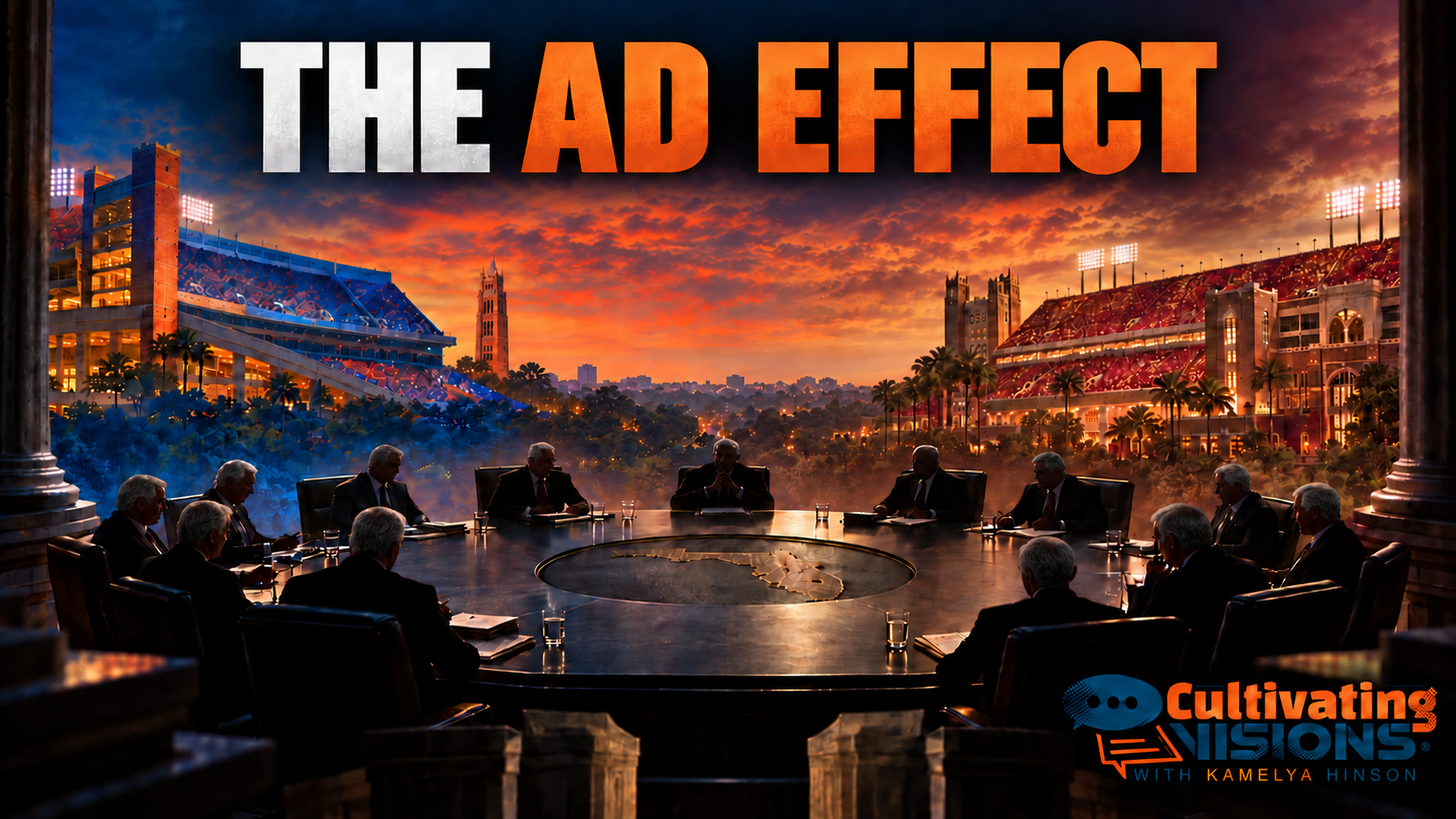
The AD Effect graphic: silhouetted silver-haired executives around a boardroom table with a map of Florida at its center, with the stadiums of University of Florida and Florida State lit up at sunset in the background.
SPORTS | THE AD EFFECT: LESSONS FROM FLORIDA STATE
Kamelya Hinson | Founder and Publisher, Cultivating Visions
Florida State has fired an athletic director who came straight from its booster office, placed a Mike Norvell-era insider in charge and begun another national search. Before Gators laugh, Florida should examine its own revolving door, where former leaders change titles but never leave, and how it shapes leadership, coaching hires and accountability.
Gator alumni and fans may be tempted to enjoy the chaos unfolding 150 miles west. Consider where Florida State stands:
It fired Vice President and Director of Athletics Michael Alford on September 14.
Its football program is 10-19 since the start of the 2024 season.
Firing head coach Mike Norvell this season could cost roughly $48 million to $51 million.
Its athletics program reported $437 million in athletics-related debt for fiscal year 2025, amid questions about whether it invested too heavily in facilities and not enough in players.
For Gator Nation, the easy response is to laugh. The wiser response is to pay attention.
Alford's downfall is not merely an FSU story. It is a warning about what can happen when fundraising, booster influence, athletic leadership and institutional loyalty become so intertwined that the people responsible for evaluating a system are also invested in defending it.
To be clear, Florida is not Florida State. The Gators play in a wealthier conference, spend more on their roster and are currently winning. That is exactly why now is the time to ask these questions. The warning signs at FSU were organizational long before they showed up on the scoreboard.
The best time to examine how an athletic department governs itself is when it is strong enough and willing to hear the answer.
FSU fired the AD before it fired the coach
FSU did not accuse Alford of misconduct. President Richard McCullough confirmed he was dismissed without cause, and Board of Trustees Chairman Peter Collins called the move the beginning of "the next phase of restructuring."
The timing was impossible to separate from football. A week earlier, FSU lost 27-24 at home to SMU as "Fire Norvell" echoed through Doak Campbell Stadium. But CBS Sports reported the decision had been trending for weeks and, according to an unnamed source, FSU's board did not want Alford selecting the football program's next head coach.
That may be the real tea.
Alford didn't hire Norvell, but he extended him twice, the second time through 2031 at about $10 million a year after Alabama came calling. When the team fell to 2-10 and then 5-7, Alford kept backing him.
FSU did not fire the man who hired Mike Norvell. It fired the man who helped make Norvell too expensive to fire.
Gator legend Steve Spurrier saw it coming nine months earlier. "Yeah, FSU. They've got some issues up there," he said on a podcast in late 2025. "They've got a coach they can't get rid of because they don't have the money to let him go."
Same building. New nameplate.
Alford arrived in 2020 as president and CEO of Seminole Boosters, FSU's fundraising organization, and became athletic director a year later. He had real wins, including two soccer national titles under Brian Pensky. Heisman winner Jameis Winston, who has said he donated more than $1 million to FSU football's NIL efforts, noticed the contrast: "Thank you @FSUSoccer for you consistently being our best football team over the years!"
But a booster executive cultivates donors, manages relationships and raises money. An athletic director must also independently evaluate coaches, contracts, spending and athlete welfare, even when doing so requires challenging the relationships and priorities the fundraising operation helped build. Alford inherited Norvell, but he chose to extend Norvell's contract and deepen FSU's financial commitment, decisions that ultimately made him accountable for an inheritance he did not create.
FSU's interim replacement doesn't break that pattern. Bruce Warwick is a respected football administrator, but FSU hired him as football chief of staff less than three weeks after Norvell arrived. He isn't an outside auditor of the Norvell era. He helped run it. And McCullough has said the permanent AD must be able to generate significant revenue, which also describes the fundraiser profile that produced Alford.
Buildings do not guarantee winning programs
Under Alford, FSU completed or advanced roughly $400 million in football facility projects, then reportedly hesitated to spend on players as roster costs exploded. Florida State built the infrastructure of a powerhouse without funding its roster like one.
That should sound an alarm in Gainesville. UF’s $1.45 billion Swamp renovation is approved and set to begin after this season, funded partly by long-term debt that still needs state approval. UF says facilities and player pay are complementary, not competing. Maybe so. But this is the same department that committed more than $45 million to paying four fired football coaches not to coach. FSU’s experience is a reminder to ask how much of the stadium bill the athletic department will carry, and who will be accountable if the revenue projections fall short.
A beautiful building can't recruit a roster, hire a coach or protect athletes. People do. That's why leadership matters. Paying top players and staff what they're worth keeps rosters stacked with talent, and a real coaching succession plan keeps UF from sliding back into another 16 years of churn and buyouts when staff moves on. Who leads matters more than what gets built.
How similar are Florida and Florida State?
Gator Nation would say, “We are nothing like them.” But their succession patterns look uncomfortably familiar. At FSU, the booster president became AD, defended the coach he inherited and was replaced on an interim basis by an administrator from inside that coach's operation. The titles changed. The relationships remained close.
At Florida, Scott Stricklin has been the central executive through three football searches: Dan Mullen, Billy Napier and Jon Sumrall. UF extended Stricklin before the 2025 season, effectively settling that he would lead the next search if Napier failed, and the Associated Press reported that he conducted the Sumrall search without interference.
Florida's results under Sumrall are encouraging. The Gators are 4-1, 2-1 in the SEC and ranked No. 16. But early victories shouldn’t end the conversation. A winning record can paint over the cracks, but it can’t repair the foundation. UF learned that the hard way when Urban Meyer walked away after the 2010 season with seemingly no succession plan and no willingness to look past old comfort zones. The program has been searching for stability for 16 years.
The deeper similarity is continuity around the decision-maker:
Phil Pharr spent 45 years with Gator Boosters, 13 as its leader, before becoming special assistant to the athletic director this year.
Scott Stricklin's contract carries that same title into the future. After his AD term ends in October 2030, he becomes special assistant to the athletic director through 2035, with $100,000 a year, an office, staff support, complimentary tickets and aircraft use valued at up to $55,000.
Jeremy Foley retired as AD in 2016 but never fully left. The staff directory still lists him as AD/Emeritus, under Administration, with an office extension.
Stricklin's contract says the special assistant role may not interfere with or undermine his successor. That safeguard raises its own question: if the role is written so it cannot shape the next AD's decisions, what is it for? A built-in, five-year career transition inside the same department gives the impression that the outgoing leader is expected to remain influential. If that is not the purpose, UF should say what the purpose is.
Together, these arrangements create a revolving door, one where people change titles but never leave the building. Former administrators remain inside the department, fundraising relationships stay concentrated, and the sitting AD selects coaches while already contracted to remain beside his successor.
Every department needs a historian. But there is a difference between keeping a historian in the room and surrounding a new leader with people who selected, funded or defended the previous administration's decisions. That influence can even shape how the department honors its own past, including which teams are acknowledged with signage in the stadium, and which former players and coaches are inducted into the Ring of Honor, a question that deserves its own feature in a future installment of The AD Effect.
Florida's risk is not that its structure is identical to FSU's. It is that a future AD could inherit a department where powerful predecessors remain present and old decisions arrive protected by contracts and loyalty.
Florida has already paid for failed decisions
The warning is not hypothetical, and it did not begin with Stricklin. Florida has repeatedly carried the cost of one football regime into the next:
Will Muschamp (hired by Foley): about $6.3 million buyout.
Jim McElwain (hired by Foley): $7.5 million settlement, paid through 2021.
Dan Mullen (hired by Stricklin): $12 million, paid through 2027.
Billy Napier (hired by Stricklin): more than $21 million, paid through 2029.
Twice, Florida has had three football coaches on the payroll at once: the current coach and two former ones.
After two football hires that would ultimately end in buyouts, many schools would have taken the FSU route and changed athletic directors first. Florida went the other way: it extended Stricklin in June 2025 and entrusted him with a third hire. Sumrall signed a six-year, $44.7 million deal that guarantees him 70 percent of his remaining pay if fired without cause.
That contract may prove to be a wise investment. Elite coaches have leverage, and competitive programs must accept risk. The concern is whether the same leadership group that recommends the risk can still evaluate it independently if the evidence changes.
Athlete welfare and coaching churn
Florida's record also includes concerns more serious than wins and losses.
Women's basketball. Tammi Reiss is the program's third head coach since Stricklin fired Amanda Butler in 2017.
Stricklin hired Cameron Newbauer in 2017. Players later described intimidation, verbal abuse and racist comments, and concerns had been raised with administrators before he resigned in July 2021. Despite warning signs and required corrective actions, UF gave him a three-year extension months earlier. Stricklin later said, "We failed in this situation." Newbauer received a $283,250 buyout.
Kelly Rae Finley was fired in March 2026 after five seasons without reaching the NCAA Tournament in her last four. Stricklin hired Reiss two weeks later.
Women's soccer. Nick Zimmerman is the third coach Stricklin has hired in less than five years since Becky Burleigh retired.
Tony Amato was fired after one season in April 2022. Players told Fresh Take Florida he made inappropriate comments about their eating habits and bodies, including around athletes who had struggled with eating disorders. To UF's credit, feedback channels added after the Newbauer case helped surface the complaints. That is what oversight is supposed to do.
Samantha Bohon was let go after four seasons and an 18-34-18 record.
Turnover alone does not prove dysfunction. But repeated hires, extensions and dismissals under the same decision-maker deserve examination, especially when some departures involve athlete-welfare complaints rather than ordinary competitive failure.
Florida's accomplishments deserve credit. Stricklin hired Todd Golden, who led men's basketball to the 2025 national championship, the first title earned by a Stricklin-hired head coach in over 16 years as an athletic director. Florida keeps winning titles across multiple sports, though many of those championships have come from coaches Stricklin inherited. That is precisely why the full picture matters. Two things can be true. Stricklin can have real wins and still have real problems. And success can make the problems easier to overlook.
The issue is not whether Stricklin has made good decisions. He has. The issue is whether UF Athletics has created enough checks and balances to catch the bad ones before UF is too invested to walk away and one bad decision sets off the next.
The lesson from Tallahassee
Florida State's permanent AD search will tell us whether the university wants change or merely relief. The strongest choice is a leader who doesn’t owe the old guard anything. Where that person comes from matters less than whether they are willing to tell presidents, trustees, boosters and famous alumni what they may not want to hear.
Florida should apply the same standard to its eventual transition. Before UF names its next athletic director, it should stop the revolving door:
Explain what the emeritus and special assistant roles are for, and whether they help a new AD or hold one back.
Choose a successor who isn't too indebted or intimidated to challenge the people still in the building.
Let the AD build their own inner circle.
Gators can laugh at Florida State's predicament today. But a coaching buyout approaching $50 million, hundreds of millions in debt and an athletic director dismissed before the third game did not materialize overnight. They were the accumulated result of decisions that once looked defensible, relationships that once looked valuable and extensions that once looked reassuring.
That is the lesson.
Preserving tradition can also preserve failed decisions, old grudges and harmful cultures. And it allows the same small circle to influence who gets honored and who gets left out. The question for Florida's eventual transition should not simply be, "Who knows the Gator Standard?"
It should be, "Who is independent enough to challenge it?"
And will UF's new president, Stuart Bell, let the old guard keep elevating followers who go along to get along, instead of leaders ready for the new era of college sports?
The AD Effect is not only what an athletic director builds. It is also what the system allows that person to inherit, protect and pass on.
Reporting current as of September 30, 2026.
About the author and disclosure: Kamelya Hinson is a graduate of the University of Florida College of Journalism and Communications and serves on the UF Digital Worlds advisory board. She was a volunteer leader with the UF Alumni Association for 16 years, where she was named leader of the year in 2019. She founded the Ancestors Dream Initiative, a nonprofit that supports Black student organizations at UF. She writes about UF as an invested alumna and an independent observer; she has no role with the University Athletic Association.
